Quick Actions
Jump through the article, share it, or save a clean link for later.
Summary
Structured Settlements vs Lump Sum: Tax Advantages & Financial Planning Structured Settlements vs Lump Sum analysis evaluates the financial stability and tax efficiency of.
Structured Settlements vs Lump Sum: Tax Advantages & Financial Planning
Structured Settlements vs Lump Sum analysis evaluates the financial stability and tax-efficiency of personal injury recovery models under Internal Revenue Code Section 104(a)(2). The framework assumes careful legal advice and deliberate hiring a lawyer decisions when structuring recovery. A complete record aligns civil litigation timelines with the statute of limitations, the discovery process under evidence rules, and qualified expert witnesses. Cost planning should align contingency fee terms with a defensible demand letter, disciplined settlement negotiation, and realistic trial preparation, including mediation or arbitration paths as appropriate. It provides a record-focused framework for settlement allocation and long-term financial security planning.
This overview explains how structured settlements vs lump sum considerations shape evidence, liability, and recovery planning.
Settlement structure decisions require a documented financial record. The record should include damages categories, projected expenses, tax treatment, and a clear plan for long-term financial stability.
Definitions - Structured Settlements vs Lump Sum: Tax Advantages & Financial Planning
Definitions used throughout this guide:
- Structured settlement: periodic payments funded by an annuity or qualified assignment.
- Lump sum: a single payment paid at settlement.
- Qualified assignment: transfer of payment obligation under federal tax rules.
- Excludable damages: amounts excluded from gross income under tax law.
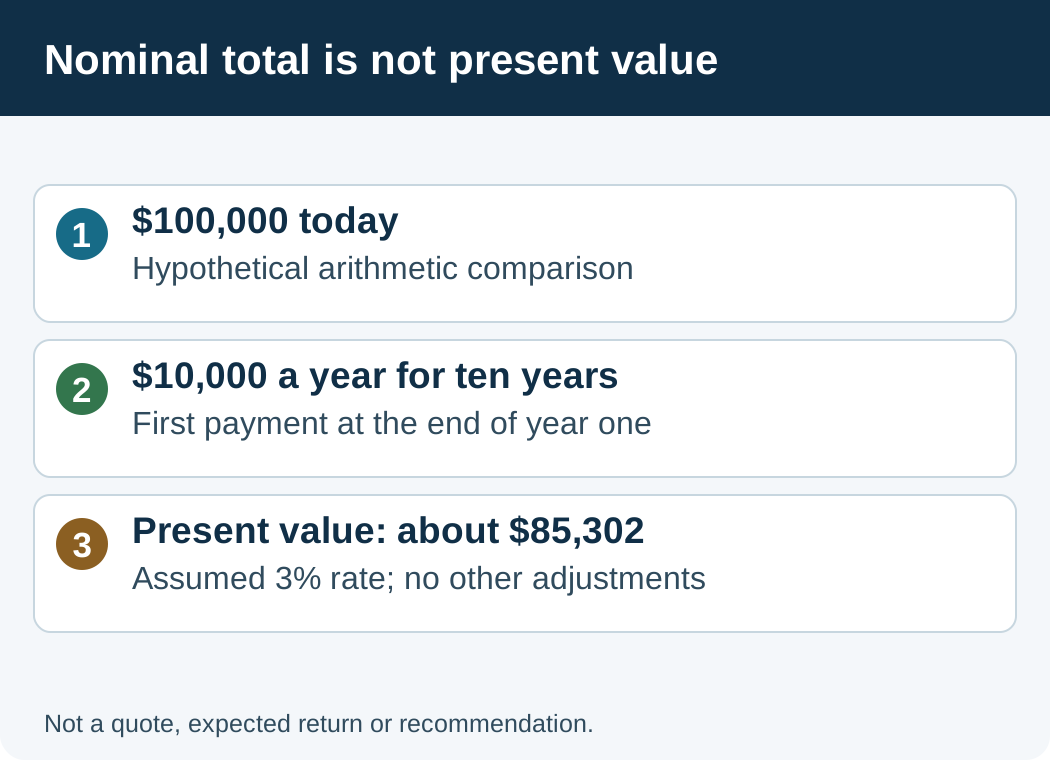
- Present value: current value of future payment stream.
Key terms in practice: a structured payout is a scheduled stream documented in the annuity schedule, while a lump sum net is the one-time payment after fees shown in the settlement statement. Tax exclusion hinges on injury classification, the discount rate is documented in the economic report used for present value, and payment security depends on annuity issuer strength reflected in carrier ratings.
Legal Framework - Structured Settlements vs Lump Sum: Tax Advantages & Financial Planning
Settlement tax treatment is governed by federal tax law, including Internal Revenue Code Section 104(a)(2) for personal physical injury recoveries and Section 130 for qualified assignments. State law governs settlement approval, minors' compromises, and structured settlement transfer restrictions. For official federal tax guidance, consult IRS Publications.
Structured Settlements vs Lump Sum: Tax Advantages & Financial Planning - Core Authorities
Tax exclusions apply to damages for personal physical injuries or physical sickness. Punitive damages and interest are generally taxable. The record should categorize damages and identify any taxable components.
Structured Settlements vs Lump Sum: Tax Advantages & Financial Planning - Qualified Assignments
Qualified assignments allow a defendant to assign periodic payment obligations to a third-party assignment company under IRS rules. The record should include the assignment agreement, annuity contract, and payment schedule.
Structured Settlements vs Lump Sum: Tax Advantages & Financial Planning - Court Approval
Many jurisdictions require court approval for settlements involving minors or incapacitated persons. The record should include approval orders and structured settlement terms.
Structured Settlements vs Lump Sum: Tax Advantages & Financial Planning - Standard of Review
Appellate review of settlement approvals focuses on legal compliance, adequacy of representation, and record support for the settlement structure.
Liability Analysis - Structured Settlements vs Lump Sum: Tax Advantages & Financial Planning
Liability analysis affects settlement value and structure selection. Strong liability supports higher settlement value and greater flexibility in payout design.
Liability posture also drives the willingness of insurers to fund a structure. A clear liability record reduces negotiation friction and supports structured funding approval.
Liability anchors:
- Strength of fault proof and admissions.
- Comparative fault exposure and allocation.
- Damages support for high-value claims.
- Insurance limits and collection risk.
Liability matrix in narrative form: liability strength depends on clear fault evidence and can be challenged by comparative fault, so documented admissions matter. Damages certainty relies on medical and economic proof, while defenses often claim losses are speculative, making expert reports important. Collection risk is tied to policy limits and coverage disputes, which a coverage chart can address. Approval needs arise for minors or protected parties and should be supported by a court order to avoid procedural defects.
Evidence Handling - Structured Settlements vs Lump Sum: Tax Advantages & Financial Planning
Evidence handling includes medical proof for exclusions, financial planning records, and settlement documentation. The record should support tax classification and payment design.
Evidence should include a clear allocation of damages that ties each category to supporting proof. A structured allocation memo supports tax treatment and avoids reclassification disputes. The record should include settlement drafts, negotiation notes, and final allocation language.
Evidence handling should also include a fee and cost summary. A transparent fee record supports net recovery analysis and helps compare structured and lump sum outcomes.
Key evidence controls:
- Preserve medical records that support physical injury.
- Document damages categories and allocations.
- Preserve settlement term sheets and payment schedules.
- Obtain annuity issuer ratings and contracts.
Evidence control considerations: medical records should include the full treatment file to support injury classification and tax exclusion. The allocation memo should itemize damages to avoid unclear tax treatment. Payment schedules must be finalized in the annuity schedule to ensure payout certainty. Court approval orders should be filed when required to prove compliance. Carrier ratings documentation supports payment security analysis.
Insurance Structure - Structured Settlements vs Lump Sum: Tax Advantages & Financial Planning
Insurance structure influences funding source and settlement timing. The record should identify primary and excess coverage and any structured settlement brokers involved.
Insurance structure factors:
- Policy limits and excess coverage.
- Insurer authority for structured payments.
- Indemnity and assignment agreements.
- Payment security of annuity issuer.
For federal civil litigation context, review U.S. Department of Justice Civil Division.
Coverage disputes should be documented with reservation letters and coverage positions. A coverage chart listing all policies, limits, and trigger conditions supports settlement planning and payment timing.
Insurer approval of a structured payment often requires advance notice and documentation. The record should include approval communications and the final funding confirmation.
Damages Valuation - Structured Settlements vs Lump Sum: Tax Advantages & Financial Planning
Damages valuation should consider present value, future care costs, and liquidity needs. A structured payout matches expenses to timelines, while a lump sum provides immediate capital for large purchases.
Damages valuation factors:
- Life-care plan costs and timing.
- Replacement cycles for equipment and housing.
- Education and retraining expenses.
- Inflation and discount rate assumptions.
Valuation should include sensitivity analysis for discount rates and inflation. A range model helps compare structured and lump sum outcomes under different assumptions.
Valuation should also account for behavioral risk and budgeting discipline. A documented spending plan supports lump sum planning and reduces volatility risk.
Damages valuation comparison: structured payouts align with periodic future care costs in the life-care plan, while lump sums require budgeting to manage the same expenses. Liquidity needs are met immediately by a lump sum but are limited under a structure, which should be documented in an expense forecast. Structured payments reduce market exposure, while lump sums increase investment risk, so the risk profile should be documented. Tax treatment for compensatory physical injury damages can be excludable under either option when qualified, which should be confirmed in a tax analysis memo.
Procedure Timeline - Structured Settlements vs Lump Sum: Tax Advantages & Financial Planning
Settlement structure decisions should align with litigation milestones and approval requirements.
Settlement negotiations and term sheet. Allocation of damages and tax review. Selection of structure options and payout design. Court approval if required. Funding and issuance of annuity.
The timeline should track mediation sessions, court review dates, and funding confirmations. These milestones affect closing and distribution timing.
Timeline risk points include tax reclassification if the allocation memo lacks itemized categories, delayed court approval without tracking, payment delays without funding confirmation, and accounting errors without a final settlement statement. Timeline controls should track the term sheet, payout design, court approval when required, assignment execution for funding, and closing distribution to avoid tax disputes, payment gaps, invalid settlements, and accounting errors.
Decision Tree - Structured Settlements vs Lump Sum: Tax Advantages & Financial Planning
Decision tree for structure selection:
- Settlement value established
- Are long-term care costs predictable?
- Yes -> consider structured payments aligned to care timeline.
- No -> evaluate hybrid structure with partial lump sum.
- Is immediate liquidity required?
- Yes -> allocate lump sum for upfront needs.
- No -> structure payments for stability.
- Is court approval required?
- Yes -> prepare approval packet and terms.
- No -> finalize structure with assignment documents.
Decision criteria for structure selection:
- Stability of long-term medical costs.
- Immediate cash requirements for housing or equipment.
- Risk tolerance for investment management.
- Payment security and issuer ratings.
Settlement Evaluation Framework - Structured Settlements vs Lump Sum: Tax Advantages & Financial Planning
Settlement evaluation should combine liability strength, damages range, and net recovery. A structured approach supports clear decision making.
Confirm liability strength and damages support. Build net recovery estimates after fees and liens. Compare structured and lump sum present values. Adjust for tax treatment and liquidity needs. Select a structure that matches long-term expenses.
Settlement range variables: structured options provide a predictable net recovery stream documented in the settlement statement, while lump sums provide immediate liquidity. Tax treatment for qualifying physical injury damages should be documented in the allocation memo for either option. Risk profiles differ, with structures reducing market risk and lump sums increasing it, which should be reflected in the financial plan. Payment security for a structure depends on carrier ratings, while lump sum security depends on cash control and management.
Tax Treatment Analysis - Structured Settlements vs Lump Sum: Tax Advantages & Financial Planning
Tax treatment depends on injury classification and payment structure. For personal physical injury recoveries, compensatory damages are generally excluded from income under federal law. Interest and punitive damages are generally taxable. The record should include an allocation memo that categorizes each component.
Payment Security Review - Structured Settlements vs Lump Sum: Tax Advantages & Financial Planning
Payment security depends on the annuity issuer and assignment company. The record should include carrier ratings, annuity contract terms, and any guaranty association limits.
Payment security review should also confirm the assignment company's obligations and the annuity funding timeline. A record of funding confirmation reduces payment delay risk.
Tax Allocation Checklist - Structured Settlements vs Lump Sum: Tax Advantages & Financial Planning
Tax allocation should be documented with clear categories and supporting evidence. A checklist reduces reclassification risk and supports consistent reporting.
- Identify compensatory damages tied to physical injury.
- Separate punitive damages and interest components.
- Document medical expense reimbursements and liens.
- Confirm assignment terms and annuity ownership.
- Preserve final allocation memo and settlement statement.
Insurance Structure and Liens - Structured Settlements vs Lump Sum: Tax Advantages & Financial Planning
Liens and subrogation affect net recovery and structure design. The record should include lien amounts, reduction negotiations, and lien satisfaction terms.
Lien resolution planning should start early. A record of lien notices, correspondence, and proposed reductions supports net recovery calculations and prevents funding delays.
Damages Valuation Methods - Structured Settlements vs Lump Sum: Tax Advantages & Financial Planning
Valuation methods should align with present value calculations and long-term expense timing. A clear methodology supports informed decision making.
Valuation should also include a written comparison of net outcomes after fees, liens, and taxes. Net after fees is based on the structured schedule versus immediate deduction for a lump sum. Net after liens is typically scheduled paydown versus immediate payoff. Net after taxes reflects the same exclusion rules when qualifying damages apply. This narrative comparison helps claimants understand real value, not only gross numbers.
Trial Readiness Review - Structured Settlements vs Lump Sum: Tax Advantages & Financial Planning
Trial readiness affects settlement leverage and structure selection. A record that supports damages categories and tax treatment improves negotiation outcomes.
Trial readiness checks:
- Allocation memo aligns with evidence and claims.
- Medical records support physical injury exclusions.
- Economic report matches payout timelines.
- Settlement drafts reflect approved structure terms.
Trial readiness risk points: allocation support must align with medical and damages records to avoid tax disputes. Payout alignment should match the economic report to prevent payment mismatches. Approval readiness depends on a complete court packet to avoid delays, and settlement terms should be finalized in the term sheet to prevent funding delays.
Procedure Timeline Controls - Structured Settlements vs Lump Sum: Tax Advantages & Financial Planning
Timeline controls should track approval deadlines, annuity funding dates, and distribution milestones. A tracking chart supports compliance and avoids payment delays.
Timeline controls should also track settlement transfer restrictions when applicable. Those restrictions affect future liquidity and should be documented in the file.
Practical Guidance for Claimants - Structured Settlements vs Lump Sum: Tax Advantages & Financial Planning
For related JusticeFinder resources:
- Medical lien negotiation guide
- Settle or go to trial decision guide
- Catastrophic injury settlement guide
Secondary keyword coverage within this guide includes structured settlement, lump sum settlement, qualified assignment, constructive receipt, Section 104(a)(2), tax exclusion, personal injury damages, present value, discount rate, annuity issuer, payment security, allocation memo, court approval, life-care plan, liquidity needs, investment risk, and net recovery. These concepts are addressed in context rather than as a checklist.
The Qualified Assignment: The Legal Logic of IRC § 130
For a structured settlement to remain tax-free, the plaintiff must never have "Constructive Receipt" of the money. If the defendant simply hands you the cash and tells you to buy an annuity, the IRS will tax the interest earnings.
To avoid this, lawyers use a Qualified Assignment. Under IRC § 130, the defendant or their insurer transfers the obligation to make future payments to a third-party assignment company (usually owned by a major life insurance carrier).
- Step 1: The defendant pays a lump sum to the assignment company.
- Step 2: The assignment company buys an annuity from its parent insurance carrier.
- Step 3: The annuity pays the plaintiff directly according to the agreed schedule.
This legal "hand-off" ensures that the money is never technically in the plaintiff's control until the moment they receive their monthly check, preserving its 100% tax-free status.
Comparison: Structured Settlement vs. Traditional Mutual Funds
When deciding between a structure and a lump sum, it is crucial to compare the After-Tax Internal Rate of Return (IRR).
Table overview: Feature, Structured Settlement (Annuity), Traditional Investment (S&P 500 / Bonds). Feature is Tax on Principal; Structured Settlement (Annuity) is 100% Tax-Free (IRC 104); Traditional Investment (S&P 500 / Bonds) is 100% Tax-Free (IRC 104). Feature is Tax on Growth; Structured Settlement (Annuity) is 100% Tax-Free; Traditional Investment (S&P 500 / Bonds) is Subject to Capital Gains Tax. Feature is Market Risk; Structured Settlement (Annuity) is Zero (Backed by Carrier); Traditional Investment (S&P 500 / Bonds) is High (Market Volatility). Feature is Management Fees; Structured Settlement (Annuity) is Zero (Built into the annuity); Traditional Investment (S&P 500 / Bonds) is 0.5% - 2.0% Annual Advisory Fees. Feature is Liquidity; Structured Settlement (Annuity) is Low (Payments are fixed); Traditional Investment (S&P 500 / Bonds) is High (Can sell at any time). Feature is Creditor Protection; Structured Settlement (Annuity) is High (State laws protect annuities); Traditional Investment (S&P 500 / Bonds) is Low (Asset search can find accounts).
Protecting Government Benefits: SNT and MSA Integration
In catastrophic injury cases, a settlement can accidentally trigger a "disqualification" from government benefits like Medicaid or SSI. To prevent this, the settlement structure must be integrated with specialized trusts.
Special Needs Trusts (SNT)
If an injured person receives a lump sum, they will likely exceed the asset limits for Medicaid. By directing the structured settlement payments into a First-Party Special Needs Trust, the money can be used to pay for "quality of life" items (travel, electronics, home modifications) without counting as an asset for benefit eligibility.
Medicare Set-Asides (MSA)
If the injured person is a Medicare beneficiary (or will be within 30 months), federal law requires that "Medicare's interests are protected." This often requires a Medicare Set-Aside.
State Guaranty Associations: The Final Safety Net
While the life insurance companies that fund structured settlements are among the most stable financial institutions in the world, what happens if one fails? This is where State Life and Health Insurance Guaranty Associations provide protection.
How it Works:
Every state has a guaranty association that steps in if an insurer becomes insolvent.
- Coverage Limits: Most states (like California and New York) provide up to $250,000 to $500,000 in "Present Value" protection for annuity holders.
- Multiple Policies: If your settlement is very large (e.g., $2 million), your lawyer should split the funding across multiple insurance carriers (e.g., $500k with MetLife, $500k with Prudential) to ensure the entire amount is covered by state guaranty limits.
Factoring Companies and the "Cash Now" Trap
Once you have a structured settlement, you will likely be targeted by "Factoring Companies" (often seen in commercials promising "Cash Now"). These companies offer to buy your future payments for a single lump sum.
The Math of the Trap:
Factoring companies use a predatory "Discount Rate" to calculate their offer.
- Example: You have $100,000 in future payments due over 10 years.
- The Offer: The factoring company might offer you only $30,000 in cash today.
- The Loss: You effectively pay a 70% "tax" just to get the money early.
Legal Protection: Under the Structured Settlement Protection Acts (SSPAs) in most states, you cannot sell your payments without Court Approval. A judge must personally review the deal and find that the sale is in your "Best Interest."
The Role of the Structured Settlement Broker
Selecting the right annuity is a technical process that requires a Structured Settlement Broker. In most high-value cases, a "Dual-Broker Model" is used, where both the plaintiff and the defense have their own brokers.
Why You Need Your Own Broker:
- Market Shopping: A broker scans all A+ rated life insurance carriers (e.g., Berkshire Hathaway, Pacific Life, USAA) to find the best internal rate of return for your specific payout schedule.
- Qualified Assignment Review: The broker ensures that the IRC § 130 language is perfect to protect your tax-free status.
- Cost-Free Service: Brokers are paid by the life insurance company, not the plaintiff. Their commission is regulated and does not reduce your settlement amount.
Annuity Commutation Clauses: Solving the Liquidity Problem
One of the biggest criticisms of structured settlements is the lack of liquidity. However, many modern policies include a Commutation Clause (sometimes called a "Hardship Provision").
How Commutation Works:
A commutation clause allows the plaintiff to "cash out" a portion of the future payments if a catastrophic event occurs (e.g., terminal illness or loss of a home).
- The Limit: Usually, you can only commute up to 10% or 25% of the remaining value.
- The Tax Risk: If not drafted correctly, a commutation clause can violate the "Constructive Receipt" doctrine, potentially making the entire settlement taxable. This is why these clauses must be strictly controlled by the assignment company.
Step-by-Step: The Settlement Signing Day Checklist
When the day finally arrives to sign your structured settlement agreement, ensure your lawyer performs this final technical audit to prevent future tax or liquidity problems.
Signing Day Audit:
Check the Spellings: A single typo in your name or Social Security number can cause the life insurance carrier to freeze payments for months. Verify the Payout Dates: Does the schedule match the life-care plan exactly? If you need a new wheelchair in 5 years, is there a "Lump Sum" payment scheduled for that year? Confirm the Assignee: Ensure the "Qualified Assignment" section names a reputable third-party company (e.g., Berkshire Hathaway Life Company of Nebraska). Beneficiary Review: If you have children, ensure they are listed as "Successor Beneficiaries" so the payments don't stop if you pass away during the "Assured Period." The "No-Change" Rule: Once signed, a structured settlement is generally Inflexible. You cannot call the insurance company and ask to "change the dates" later, so the sign-off must be perfect.
Source Box (Official .gov & .edu References)
- Internal Revenue Service (IRC § 130): Full text of the qualified assignment rule. View Site
- CMS (Medicare Set-Aside): Official guidelines for protects Medicare's interests in liability settlements. View Site
- SSA (Special Needs Trusts): Social Security Administration rules on first-party SNTs and SSI eligibility. View Site
- NSSTA (National Structured Settlements Trade Association): Industry standards and carrier data. View Site
- National Organization of Life and Health Insurance Guaranty Associations (NOLHGA): Information on insolvency protections by state. View Site
Final Checklist - Structured Settlement Planning
- IRC § 130 Compliance: Confirm the settlement agreement contains the mandatory "Qualified Assignment" language before anyone signs.
- A.M. Best Rating: Is the annuity carrier rated A or higher to ensure long-term payment security?
- MSAs Analysis: If the plaintiff is on Social Security Disability (SSDI), has a "Medicare Set-Aside" allocation been calculated?
- No "Constructive Receipt": ensure the defendant pays the assignment company directly-the money should never touch the plaintiff's or lawyer's trust account.
- Inflation Protection: Have you added a "Cost of Living Adjustment" (COLA) rider (e.g., 3% annual increase) to protect purchasing power over 30+ years?
- Beneficiary Designation: Is an "Assured Period" included so that if the plaintiff passes away, the payments continue to their family?
Related Resources
For broader context, review the Legal Process hub.
Related Guides
- Birth Injury Lawyer: Cerebral Palsy & Medical Malpractice Guide
- Can I Sue After Workers Compensation? Third-Party Liability Explained
- Catastrophic Injury Settlements: Life Care Plans & Million-Dollar Claims
Pillar guide: Contingency Fee Agreements: 33-40% Standard & Hidden Costs
Helpful Tool
Use the Accident Claim Deadline and Calendar Tracker Google Sheets to organize documentation, expenses, and insurance claim records while applying this guide.
Editorial Accountability
Reviewed public legal information with named human oversight
This guide is authored by Ilyass Alla, reviewed through the JusticeFinder Editorial Team, and may use JusticeAI for source discovery and terminology checks. Final drafting, editing, and publication approval remain human decisions.
- Author: Ilyass Alla, Legal Research Editor
- Review layer: Source Verification and Quality Control
- Scope: Educational legal information only, not legal advice
- Last editorial update: February 14, 2026
Ilyass Alla
Legal Research Editor
Ilyass Alla is a legal research editor focused on U.S. accident law, insurance claims, and litigation process education. His work focuses on translating complex legal procedures into clear informational guides for the public.
View author profileTopical Authority Cluster
Authority cluster for damages modeling, liens, structured payouts, and catastrophic-loss planning.
Payout-structure support page.
Authority Page
Catastrophic Injury Settlements: Life Care Plans & Million-Dollar Claims
Primary authority page on large-loss damages, life-care plans, and major-injury valuation.
Related supporting articles
Medical Liens in Personal Injury: Negotiation & Reduction
Medical-liens support page tied to net recovery.
Spinal Cord Injury Lawyer: Compensation & Lifetime Care Guide
Injury-specific catastrophic-loss support page.
Social Security Disability After Injury: Application & Appeals Guide
Benefits coordination support page after serious injury.
More Legal Process Guides

Catastrophic Injury Settlements: Life Care Plans & Million-Dollar Claims
Catastrophic Injury Settlements: Life Care Plans and Million Dollar Claims Severe injury cases require disciplined proof, long range cost modeling, and careful compliance with.

Medical Liens in Personal Injury: Negotiation & Reduction
Expert guide on medical liens in personal injury cases. Negotiate and reduce liens from Medicare, Medicaid, and private plans to maximize your net settlement.

Spinal Cord Injury Lawyer: Compensation & Lifetime Care Guide
Spinal Cord Injury Lawyer: Compensation & Lifetime Care Guide Spinal cord injury lawyer analysis focuses on catastrophic injury litigation, proof of causation, and lifetime care.

Social Security Disability After Injury: Application & Appeals Guide
Social Security Disability After Injury: Application & Appeals Guide social security disability after injury Social security disability after injury analysis focuses on the SSA.

Personal Injury Statute of Limitations: State-by-State Deadline Guide
Personal Injury Statute of Limitations: State by State Deadline Guide Personal Injury Statute of Limitations rules define the filing deadline that determines whether a civil claim.

Motorcycle TBI Settlements: The 'Invisible Injury' Legal Guide
Expert guide on motorcycle TBI settlements. Learn how to prove cognitive deficits and invisible injuries using neuropsychology, imaging, and expert testimony.
Litigation Planning Tools
View all toolsThese worksheets help organize records, deadlines, and claim documents for legal-process and injury-liability topics.
Personal Injury Expense and Damages Tracker Google Sheets
It collects economic and non-economic loss categories in one place so total damages can be reviewed as a system.
Use it when the claim has multiple loss categories and the issue is total damages organization, not one isolated expense.
Personal Injury Medical Records Tracker Google Sheets
It tracks which records were requested, received, and still missing before the file is reviewed or packaged.
Use it when multiple providers or facilities are involved and records requests are no longer simple to track from memory.
Settlement Demand Letter Organizer Google Sheets
It organizes the numbers, proof, and narrative pieces that sit behind a settlement demand.
Use it when investigation and damages development are far enough along that the file needs a coherent demand package.
Personal Injury Statute of Limitations Tracker Google Sheets
It keeps filing and notice dates from drifting when multiple deadlines affect the same matter.
Use it as soon as timing matters and you cannot afford notice, filing, or service deadlines to live in separate calendars.
Frequently Asked Questions
What is the main tax advantage of a structured settlement?v
Are lump sum settlements taxable?v
What is a qualified assignment?v
Why is an allocation memo important?v
How does a structured settlement help budgeting?v
What is present value?v
Continue Exploring
Keep moving through the topic with the next guide, the category hub, or a related calculator.